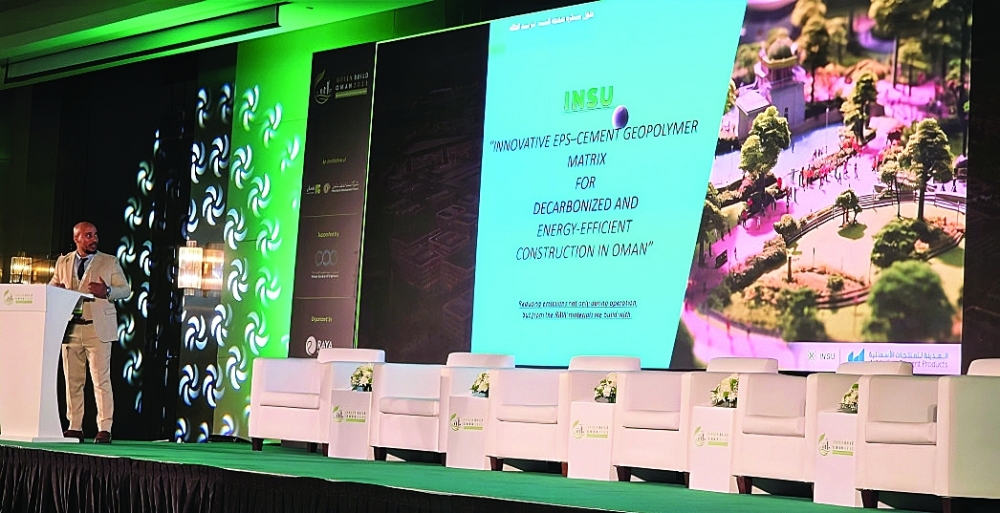











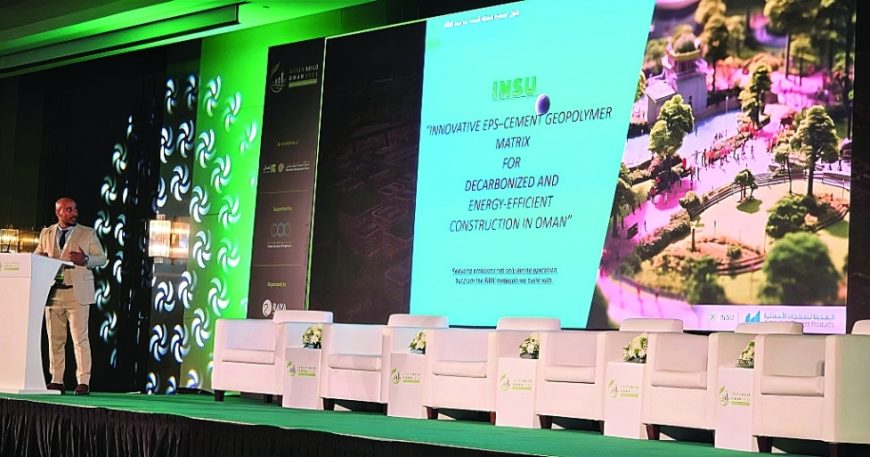
MUSCAT: Oman’s construction sector is under growing pressure to align with stricter energy efficiency targets and lower carbon pathways as sustainability moves from policy ambition to regulatory reality. Developers are increasingly being challenged to deliver buildings that perform better over their entire lifecycle, not just at the operational stage. According to a presentation delivered during the Green Build Oman Summit held recently in Muscat, expanded polystyrene (EPS)–cement composites are emerging as a viable solution to meet these evolving demands.Addressing industry stakeholders, Youssif AbdelAleem, Technical Manager at Al Madina Cement Products, said the future of construction in Oman depends on materials that combine energy efficiency, environmental responsibility and practical application. “We did not choose EPS randomly,” he said. “We chose it because it brings together the four pillars the market is demanding today: thermal insulation, sustainability, cost efficiency and ease of operation.”AbdelAleem explained that EPS-based cementitious and geopolymer matrices rely primarily on entrapped air rather than manufactured gases to achieve insulation. Air, he noted, is the most effective and natural insulating material available. “The best-selling insulation material in the world is air,” he told the audience. “When air is entrapped inside EPS, it resists heat transfer by reducing both conduction and convection, which is critical in hot climates like Oman.”This approach has significant implications for decarbonisation. Many conventional insulation materials depend on manufactured gases with very high global warming potential (GWP), often exceeding 1,400. Under international agreements such as the Montreal Protocol, such materials face increasing restrictions in the coming years. “Most insulation products that rely on manufactured gases will be phased out because of their high GWP,” AbdelAleem warned. “EPS systems, depending on density and specification, can have a global warming potential as low as 7 to 41, which is a massive difference.”